Monday, January 21, 2008

Apis part1


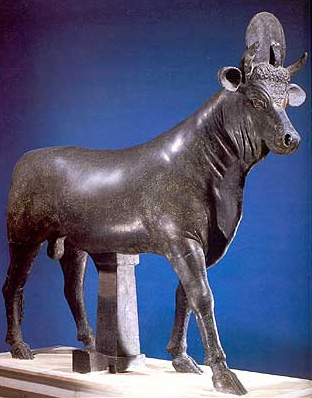
APIS, a sacred bull worshipped at Memphis from the earliest period, having probably been introduced into the religious system as early as the 2nd dynasty by the king Kaiechos, who instituted the worship of Apis and the bull Mnevis.
His name in hieroglyphs was Hapi, and meant "the hidden," as he had to be discovered amidst the cattle, which was done by certain diacritical marks. According to the hieroglyphic inscriptions which accompany his form, he was the second birth or living incarnation of the god Ptah, the Egyptian Hephaestos or Vulcan. Apis is first mentioned and appears in the monuments of the 4th dynasty. The two bulls Apis and Mnevis are considered to have respectively represented the moon and sun, and seem both to have been buried at Memphis.
He was supposed to have been born of a virgin cow, rendered pregnant by a moonbeam or a flash of lightning. The mother of Apis, according to Strabo, had a part of the temple of the Apis reserved for her use; and the hieroglyphic inscriptions record a prophet or priest attached to her service. On the monuments she shares the honours of the bull, and is represented under the attributes of Athor as a goddess with a cow’s head. This cow had her especial name, these animals having each a separate appellation. According to the Greek writers Apis was the image of Osiris, and worshipped because Osiris was supposed to have passed into a bull, and to have been soon after manifested by a succession of these animals. The hieroglyphic inscriptions identify the Apis with Osiris, adorned with horns or the head of a bull, and unite the two names as Hapi-Osor, or Apis Osiris. According to this view the Apis was the incarnation of Osiris manifested in the shape of a bull. But besides this title, the monuments style Apis the son of Ptah, who was supposed to be his father by the sacred cow, or the second life of Ptah. Other monuments, indeed, declare him to have had no father, and to have been Onnophris or Osiris, but this conflict of ideas must have arisen from his material and spiritual nature, uniting the soul of Osiris or Ptah mystically with the sacred animal. Besides the mother of the Apis, a cow was annually exhibited to him decorated with the same insignia -- that is, a disk between the horns and a housing on the back, to judge from the insignia found on the bronze figures of the Apis -- and then slaughtered the same day, for no issue of the divine animal was permitted to exist.
According to other authorities several cows were kept in the Apeum on the announcement of the birth of an Apis, the sacred scribes and priests proceeded to verify the characters of the calf. The marks of the Apis were a black coloured hide, with a white triangular spot on the forehead, the hair arranged in the shape of an eagle on the back, and a knot under the tongue in shape of a scarabaeus, the sacred insect and emblem of Ptah, a white spot resembling a lunar crescent at his right side. These marks have been supposed to be for the most part certain arrangements of the hairs of the hide as seen in some animals. A house was built to the calf Apis facing the east, in which for four months he was nourished with milk. When he had grown up he was conducted, at the time of the new moon, to a ship by the sacred scribes and prophets, and conducted to the Apeum at Memphis, where there were courts, places for him to walk in, and a drinking fountain. According to Diodorus, he was first led to Nilopolis, and kept there 40 days, then shipped in a boat with a gilded cabin to Memphis, and he was there allowed to be seen for 40 days only by women, who exposed themselves to him. Like all the sacred animals his actions were oracular, and he had two chambers, his passage into one of which was deemed fortunate, and into the other unlucky. Thus the licking the garments of a visitor was supposed to prognosticate a tranquil but short life, and his refusal of the food offered to him by the hand of Germanicus, the approaching death of that hero. The actions of the children who played around his shrine or accompanied his processions were also considered oracular. The day of his birth was kept as an annual festival.
His life was not allowed to exceed 25 years, and should it have attained that maximum reckoned from the date of his enthronisation, the Apis was killed and thrown into a well, in which the priests asserted he had precipitated himself. This well was known to no one, and no one was allowed to reveal the place of burial. If the Apis died before the 25 years he received a splendid burial at Memphis in the Serapeum, for after death he was called the osor-hapi, or Serapis. This funeral was expensive; his body was placed in a barge, and accompanied by a procession of a Bacchanalian character, passing through the brazen doors of Memphis. As universal joy prevailed at his discovery, so his death threw all Egypt into a general mourning, and every one shaved off his beard. This mourning continued till the discovery of another Apis.

Egypt finds 4 000-yr-old mummy


Cairo - Egyptian archaeologists have discovered the funerary remains of a doctor who lived more than 4 000 years ago, including his mummy, sarcophagus and bronze surgical instruments.
The upper part of the tomb was discovered in 2000 at Saqqara, 20km south of Cairo, and the tomb came to light in the burial pit during cleaning work, said state news agency Mena on Tuesday, quoting Egyptian government antiquities chief Zahi Hawass.
The doctor, whose name was Qar, lived under the 6th dynasty and built his tomb near Egypt's first pyramid. The 6th dynasty ruled from about 2350 to 2180 BC.
Hawass said the lid of the wooden tomb had excellent condition. "The linen wrappings and the funerary drawings on the mummy are still as they were," he said.
"The mask which covers the face of the mummy is in an amazing state of preservation in spite of slight damage in the area of the mouth."
The tomb also had earthenware containers bearing the doctor's name, a round limestone-offering table and 22 bronze statues of gods.

collosal statue of Ramses II at memphis


This too is echoed by the immense private tombs found on the Theban West Bank, dated to this period. I have therefore chosen not to use the name "3rd Intermediate Period" and have the Late Dynastic Period immediately follow the New Kingdom. What is called the "Late Period" in most history books, has also become part of this "Late Dynastic Period". During most of the New Kingdom, the wealth and power of the Theban high-priests had slowly increased. It is possible that 18th Dynasty King Akhenaten’s Amarna-revolution was an attempt to break this power. If so, the attempt failed, for a mere 20 years later, the old temples were reopened and the high-priests were reinstated in their offices. Whatever Akhenaten’s motives for his religious revolution, the reinstatement of the traditional cult was a victory for the high-priests of Thebes. At the end of the New Kingdom, during the later years of Ramesses XI, a Theban high-priest named Herihor, possibly a brother-in-law to Ramesses XI, was able to combine his influential office with the office of vizier and he bore the honorary title of "viceroy of Kush". He was so wealthy that he was able to build parts of the Khonsu-temple in Karnak and he even usurped the royal privilege to have his name written in a cartouche! When Ramesses XI died, the dynasty of high-priests had become a major political factor. The kings of the 21st Dynasty were probably related through marriage to the last Ramessides.
They moved the capital from Pi-Ramesse to Tanis, both in the Nile Delta, probably because the canal neighboring Pi-Ramesse had dried out. At Tanis they launched an elaborate building activity, one that was to rival the temple of Amun in Thebes and which also included the moving of temples and palaces from the old capital Pi-Ramesse to Tanis. They also moved the royal necropolis from the Valley of the Kings on the Theban West Bank to Tanis, where the intact tomb of Psusennes I has been discovered in the late 1930’s. Another important political factor was the Libyan military, which had been integrated into the Egyptian army and police force during the late New Kingdom. At the end of the 21st Dynasty, one of those leaders, who was married to the daughter of the last king of the 21st Dynasty, came to power. He founded a new dynasty, the 22nd, also called the Libyan or the Bubastide Dynasty since the Dynasty was founded by Libyans who lived in the Delta-city of Bubastis. The early Bubastide kings were powerful rulers who were able to re-establish Egyptian presence in Syria-Palestine. They were also able to determine who would be high-priest in Thebes and they often picked someone from their own family, thus reinforcing the Egyptian unity. But dynastic rivalry would soon bring an end to the newly found unity. In Leontopolis, also in the Delta, a 23rd Dynasty was proclaimed. This example would soon be followed by Tefnakht, a prince in the Delta-city of Sais, who founded the 24th Dynasty. Not only was Egypt divided between the Delta and Thebes, now the Delta itself would be divided as well. Taking advantage from these internal conflicts, a new power arose in the South, in Nubia. There a dynasty had come to power intent on conquering Egypt. In an effort to confront this Nubian invasion, the three Delta-dynasties allied themselves, but they were defeated.
The 25th Dynasty would be a Nubian Dynasty. The monarchs of the 25th Dynasty ruled the larger part of Egypt -only the 24th Dynasty from Sais seems to have maintained its independence- from their own capital, Napata, near the 4th cataract, but they would rule it following the old Egyptian traditions. The high quality craftsman-ship of the 21st and 22nd Dynasties, as shown in this death mask of Psusennes I, does not justify this period being dubbed an "inter-mediate" period. The Nubian kings of the 25th Dynasty followed the ancient Egyptian traditions, as is shown by this statue of Taharqa. The peace and stability resulting from the Nubian conquest was brought to an end by another external factor: the Assyrians. Although the presence of the Assyrians in Egypt has been a short one, its results were devastating. The once glorious Thebes was plundered, ransacked and many wonderful temples, among which the mortuary temple of Ramesses II, were destroyed. Fortunately for Egypt, the Assyrians were forced to return to Assur, leaving the king of Sais, Psamtek I, the opportunity to take control of the entire country. With him began the 26th Dynasty and a new era of stability and prosperity in Egypt. For more than a century, the 26th Dynasty would rule over Egypt, until it was defeated by Persian invaders. The latter part of the Late Dynastic Period starts and ends with a Persian occupation. The first Persian occupation, also known as the 27th Dynasty, lasted for more than a century. It was brought to an end by Amyrtaios, the only king of the 28th Dynasty, who succeeded in ridding Egypt of the Persian yoke and was able to re-establish control over the entire country. Egypt’s regained independence lasted some 60 years, during which the kings of the 29th and 30th Dynasties ruled the country and re-established all of its traditions. The second Persian occupation would only last for 10 years, but it was one of the darkest pages in the history of Ancient Egypt: temples were plundered, holy animals were butchered and the people were subjected to demanding tributes. Egypt’s ordeal during this occupation would make it ready to welcome the Macedonian king Alexander the Great as its liberator. With the "conquest" of Egypt by Alexander, Egypt would become a Hellenistic state and a new era had begun